Software Sovereignty: An Antidote to Enshittification
How many subscriptions are you paying for right now?
And how many of those tools actually work the way you do?
For years, my honest answer was: none of them — because I didn’t have the skills to make my own. But now we’re able to build tools that fit us exactly and no longer have to pay for ones that don’t. This is what I’m calling software sovereignty. And it can free us from the continual enshittification of software.
For people like me — with ADHD, or any kind of neurodivergence — it can feel limiting, trying to fit yourself into tools that weren’t made for you, or for how your brain works. And that’s where I see immense benefit with AI: in finally allowing us to build tools that actually work for our brains.
I’ve always built my own tools — just never digital ones
I’ve already been doing this for years with my analog tools. Notebooks, whiteboards, pinboards, scrappy bits of paper, post-it notes. But digitally, I was stuck with however the tool worked.
I customised Notion heavily for a few years and absolutely loved it. But Notion is a bit like having a Lego box with only a small handful of pieces. So, whilst I could use it to build custom systems, I was still constrained by what Notion gave me.
That changed when I started my Claude subscription. The last few months have suddenly opened up this huge opportunity for me to finally build apps in the ways that work for me. And the magic toolbox for me has been Obsidian.
Obsidian allows you an almost infinite amount of customisation — which, unlike most other software apps, means you’re not trapped into whatever the company decides it wants to build.
As a lot of people are experiencing at the moment, that involves adding AI features left, right, and centre. Many users don’t want them — and are then forced to pay extra when they didn’t even want it in the first place.
The idea of software sovereignty means you can add AI where you want it — and if you don’t want it, you don’t have to have it.
Building the app I actually needed
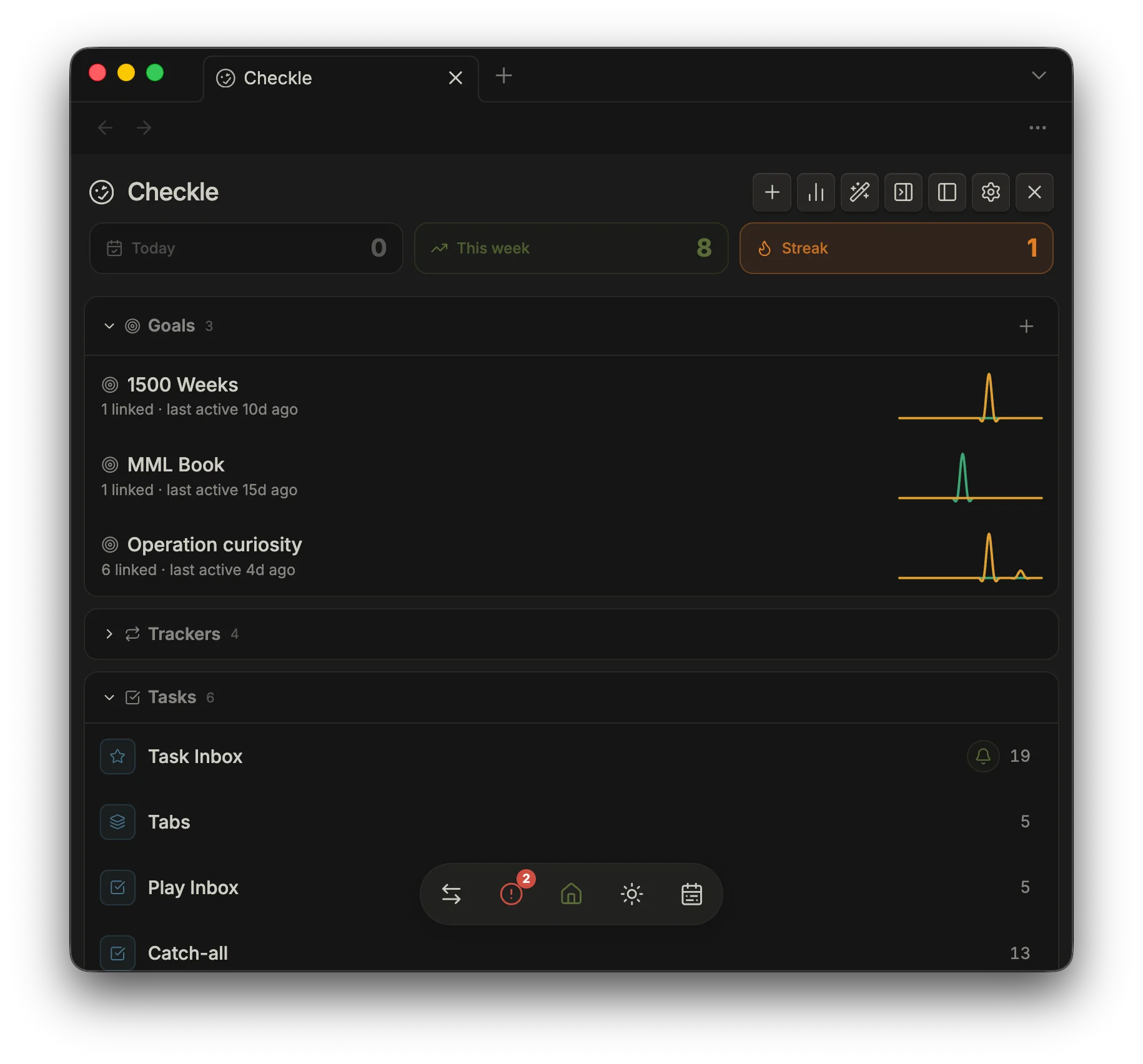
One of the apps I have built for myself is Checkle. It started off as a simple checklist plugin built into Obsidian but it quickly evolved into my primary task management app because I was able to build it with the help of Claude in exactly the way that I needed it to work.
This is software sovereignty in action.
Over the last couple of months Checkle has evolved. I’ve been adding new features — though unlike software companies, I’ve only been adding the features that I actually want and need. On my computer I built a lightweight Mac menu bar app that allows me to do quick capture via a keyboard shortcut (inspired by Todoist’s Mac capture pop-up). This is helpful for capturing tasks on the fly without having to open the app. For someone with ADHD, having that kind of frictionless capture system is everything — it allows me to stay super focused on the task at hand and not get distracted by opening another app.
I find the Obsidian mobile app to be a bit slow and clunky — not quite the UI or UX I like. So I decided to build my own iOS app to manage my tasks with ease via a personalised user interface with Obsidian as the back-end data storage. This means when I’m at my computer I can work in my Checkle Obsidian plugin and everything is in sync with my phone. By building an iOS app, I can capture tasks quickly and easily and add features like notifications, reminders, Siri integration, widgets — all of which you can’t do just purely by using Obsidian.
This allowed me to build a task management ecosystem that works exactly how my brain does.
And cancel my Todoist subscription.
I’ve added the ability to assign an estimated time to each task. There’s a planner mode, which has been super helpful to automatically calculate how much time I’ve estimated for tasks for that day. I can add in my available time for the day and it syncs with my calendar so if I’ve got an hour meeting it takes that off my available time. So I always know, from a time perspective, how much time I’ve actually got left in my day, and what tasks are taking up what time.
For ADHD brains, this helps with time blindness and accidentally over-committing. Many times I have optimistically assigned lots of tasks to the day, not really thinking about how long they would take. Then at the end of the day I feel bad about myself because I didn’t get all the tasks done.
The reality isn’t that I didn’t do anything, it was just that I had dramatically over-planned for my day.
So by being able to estimate task time, see that calculated as a total and plan realistically around that, it actually helps me to eliminate feeling like a failure at the end of the day.
One app to rule them all
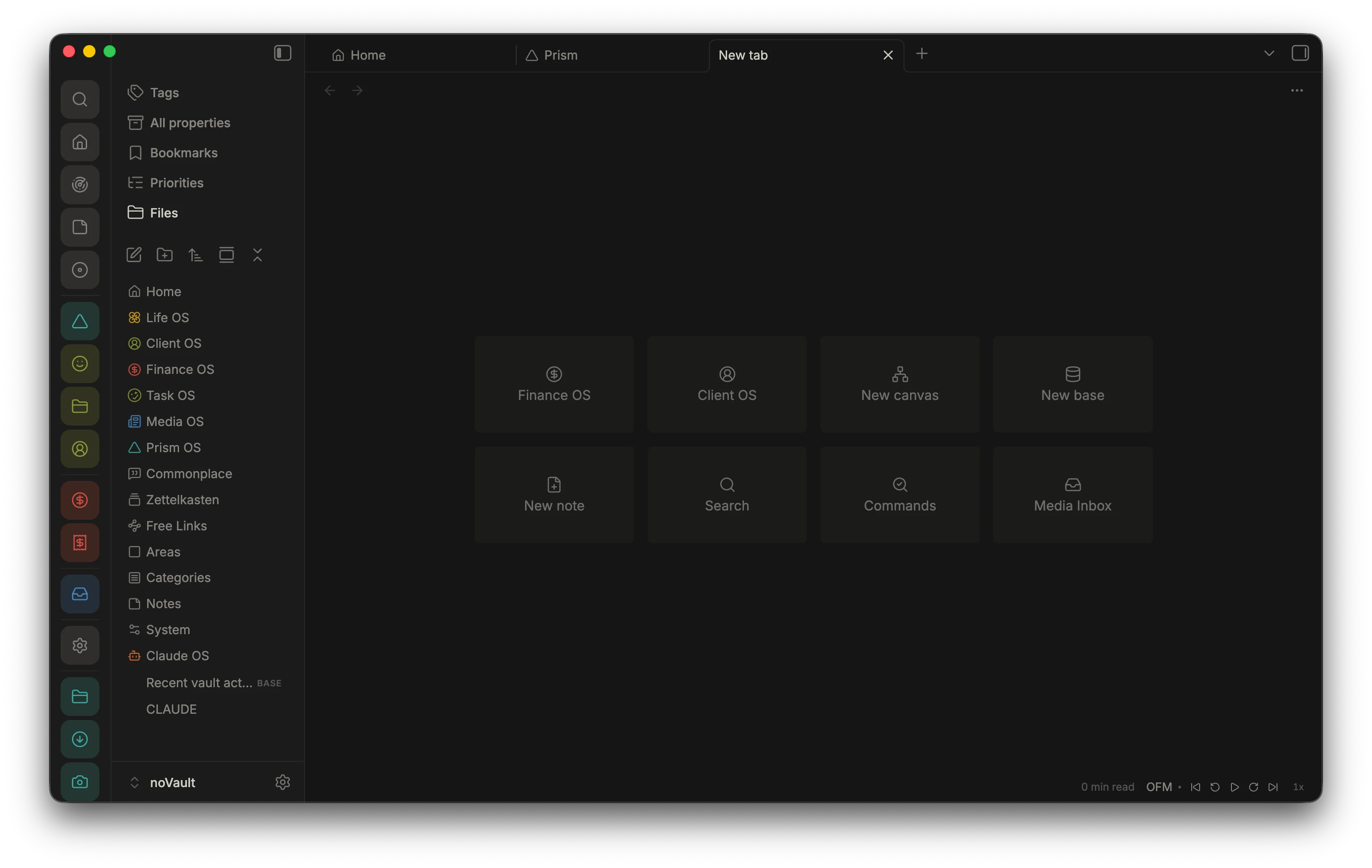
Making my own tools has meant that instead of relying on multiple apps to manage each area of my life (and subsequently increasing my surface area of distraction), I’ve been able to condense most things into one app — Obsidian.
I’ve been on a mission to rebuild everything I possibly can into Obsidian, because it’s a controlled environment where I don’t allow distractions, where it’s work-focused and where there are no feeds or algorithms trying to get me to do other things.
I’m very intentional with what I have inside Obsidian. It’s purely things that I’ve chosen to put in there and that I want to be in there. I have a lot of dashboards that help me surface the information I want, when I want it. I did consider trying to get email inside Obsidian but decided against it because your email inbox is somebody else’s to-do list.
What software sovereignty isn’t
Software sovereignty is not about distraction. Many people find that when they try to customise their tools they fall into the trap of endless customisation — especially with tools like Notion and Obsidian, because they do allow for a lot of flexibility.
Software sovereignty is about having increased autonomy over the tools you use so that you can support your life and your goals in a way that is more personalised and more suited to your particular needs.
There is a balance between building your own tools and spending a lot of time on them versus building basic tools and then testing and iterating from there. I’m definitely someone who can be guilty of trying to build the ultimate thing from the get-go, and sometimes not necessarily building to a need, but building to a grand vision. But those are two very different things. It takes a level of discernment to figure out what you actually need versus what’s cool, looks good and is fun to tinker with.
You don’t need to know how to code
The beauty of right now is that we have some incredibly powerful AI tools in our hands that we can use to create apps tailored to us in hours instead of months.
If you feel that you don’t have the skills to do something like this — I would gently challenge that. If you have the ability to say what you like and what you don’t like, then I would argue that you can build your own app that suits your needs. You can start with what feels like a vague idea and you can get the AI to work with you, gradually building it and iterating over time.
And finally — there’s an interesting question here about what the future of software is if everyone can make their own apps with a simple prompt and a process of iteration. I feel it’s going to result in a lot of open-source software and open up a lot of possibilities for us to free ourselves from subscriptions that trap us in and get raised year after year — because we now have the ability to build our own apps from just one subscription. The best part is you don’t even have to pay a subscription if you use open-source AI models.
For the first time, we have the opportunity to reclaim autonomy over our digital tools and how we use them.
So, how many of your tools actually work the way you do? And what would you build, if the answer was up to you?